It has become an end-of-year tradition, for good or ill, for me to review what’s been going on in the immigration law world, look ahead and share a little of where we are at here on Free Movement. I find it a useful and interesting process.
It looks like I made few predictions last year, happily. On immigration policy, it was always clear that net migration was going to fall. And it has. I certainly did not predict the nature of the reforms in the legal migration white paper. I return to that below. On asylum, I suggested there might be movement on a returns deal with France “at some point” and one was reached. I said the initial decision backlog would be cleared and it hasn’t – but it has reduced a lot. I thought the appeals backlog would persist for “at least” a couple of years. I was right to identify that as an important issue but wrong on the direction of travel and timescale; it will never be reduced on current trends, it will only rise and rise. After small boat arrivals, it is the biggest real immigration and asylum issue the government faces.
Citizenship and immigration
It looks like 2025 will represent a turning point in UK citizenship policy. Here, I use the word “citizenship” in the wider sense rather than the narrow legal one to which readers of Free Movement will generally be accustomed.
Citizenship is about who “we” are.
Citizenship policy is about how “them” become “us”.
Immigration policy is different but related. It is about the admission of “them” to “our” space, our country. It is different to citizenship policy because only a proportionately tiny number of immigrants will ever become citizens.
Immigration policy is about the conditions for entry. Citizenship policy is about the conditions for staying permanently and becoming part of the host society.
One of the many problems with the Labour government’s approach to citizenship and immigration is that it has confused one with the other.
In the United Kingdom, those who have settled status, formally called indefinite leave to remain, are, in effect, “us”. They have similar rights to actual citizens and will very likely live here the rest of their lives. Their children will automatically be born British citizens.
In a white paper entitled “Restoring control over the immigration system”, the government proposed to lengthen the standard period for an immigrant to settle in the UK from five years to 10 years. This is a change to citizenship policy, not to immigration policy.
Changing the criteria for citizenship cannot possibly have any meaningful effect on the numbers of immigrants. Making citizenship worse or harder to get might conceivably change the type of migrant who comes here. But this would be for the worse, as far as government policy is concerned, because the highest skilled or highest value migrants might well choose to go elsewhere instead.
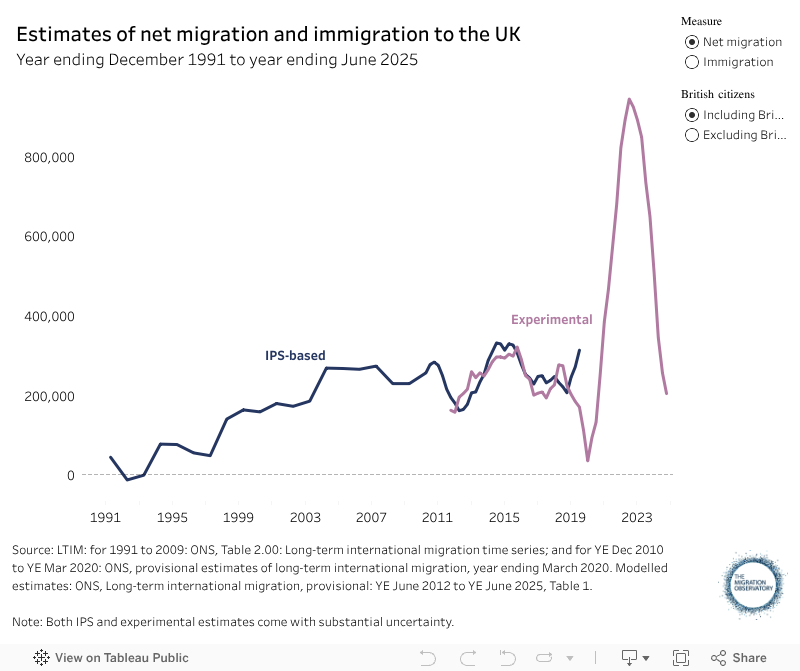
To change the numbers arriving, the government just has to change the criteria for granting visas. The last government made it far, far easier to qualify for available visas and imposed no cap. Numbers therefore increased. When the criteria for visas were considerably tightened and narrowed, numbers fell again. Dramatically. See the Migration Observatory chart below. The criteria for acquiring settlement has got nothing whatsoever to do with this.
The effect the settlement changes will have is that they will delay and undermine the long term integration of those migrants who do come to the United Kingdom. It will be harder for migrants to get good accommodation and jobs. They will be locked into work visas tied to a specific job for a specific employer for 10 years or more and therefore handicapped in the job market and vulnerable to employer exploitation. The extortionate immigration fees they have to pay mean they and their children will have far, far less money than their peers. Their children will not be born British citizens, unlike at present. They will be apart from us. And when they do eventually become settled, become one of us, the disadvantages they have experienced in the meantime will have lifelong impacts.
Some sort of probationary and transitional period is usually going to be required for some migrants to become settled and citizens. From the coming into force of the Immigration Act 1971 to the present day, that period has been five or six years here in the UK. During that time, the UK has also been one of the most successful countries in the world at integrating migrants and their families. That now looks set to change.
This is an historic reversal of UK policy and, specifically, of Labour policy. From Labour’s loss of the parliamentary seat of Smethwick in 1964 until about 2000, Labour’s policy on race and immigration, espoused by the likes of Richard Crossman, Frank Soskice, Roy Hattersley and Roy Jenkins, was to limit the number of arrivals and actively integrate those who came. Unlike his successor Kier Starmer, Harold Wilson was willing to publicly condemn outright racism. Referring to then leader of the Conservatives, Alec Douglas-Hume, and the newly elected outspoken racist Peter Griffiths, Wilson said in the House of Commons:
If Sir Alec does not take what I am sure is the right course, Smethwick Conservatives can have the satisfaction of having sent a member who, until another election returns him to oblivion, will serve his time as a parliamentary leper.
Griffiths was popular; he’d literally just won an election. A lot of people agreed with him and, later, with Enoch Powell. And that’s why it was so important for other elite figures publicly to condemn those views. There are plenty of bad things to say about Labour’s past immigration policy and where the line was drawn. But at least the then leader of the Labour Party — and in the case of Powell the leader of the Conservative Party — knew the importance of drawing a line and what to do when it was crossed.
Asylum
The proposed change to the pathway to settlement for refugees is bad for the same reasons as for other migrants. Instead of helping refugees establish new lives here and helping them make the best of things, the government has decided to maker their lives as difficult as possible. As with the change for lawful migrants, this makes integration harder.
It is worse in the case of refugees, though, because once they reach the UK they have no choice about where they live. This is not the case with other migrants, who do ultimately have some choice. Refugees cannot return to a country where they face persecution. They cannot, no matter what some might wish, move to a country through which they travelled to the UK because none of those countries will let them in. This is their home. Unless their country becomes safe, an issue over which they have no control and which is very unlikely in many cases.
The scrapping of family reunion rights for refugees is a tragedy for every family it affects. A right to family reunion was never formally incorporated into the Refugee Convention but most countries respect the human need for refugees to live with their families and recognise that risk to the refugee may manifest as risk to the family. After all, a recognised refugee has no choice of their country of residence. It might be said they had some choice about where they fled but once they are recognised they will usually be able to live in one of only two countries: their own, where they face persecution, or their country of refuge. The government’s new policy on refugee families is that they are not permitted to have them.
Meanwhile, the government still seems to have no plan on what to do about asylum appeals. We have been told that the existing system will be scrapped but there has been no news on what might replace it or how this will address the underlying problems that are causing delays in the existing system: lack of judges, lack of lawyers, the need to have a fair process and fair hearing in a life and death case.
I have an alternative proposal: scrap cross-examination by Presenting Officers. It is what makes hearings take as long as they do. It is routinely so badly done it’s either a waste of time or the refugee’s case is actually stronger at the end of it rather than weaker. And if initial decisions were better quality and focused on real issues rather than silly “credibility” points that are never properly developed — if the Home Office case is that the refugee is a lying liar who lies, they should just say it and make that case — then appeals could be more of a review than, as at present, effectively starting from scratch. There would be less need for expert reports, country information could be more focussed and judges’ decisions easier to write and shorter. And the Labour government’s current policy of refusing asylum cases at the initial stage which will only go on to be withdrawn or allowed at an appeal hearing years later is administratively insane. They really should stop doing that.
This would be more akin to the much-vaunted Danish model. A recent article by Ali Ahmadi, Fiona Costello and Professor Catherine Barnard takes a look at Labour’s asylum appeal plans, such as they are:
This new system is to be modelled partly on the Danish system. Denmark’s Refugee Appeals Board does deliver final decisions quickly and has very few onward challenges. However, Denmark also has far higher initial grant rates (around 65–70 per cent) than the UK (47%) and invests heavily in high-quality first decisions.
Hat tip to CJ McKinney for spotting that article.
Here on Free Movement
Google Analytics tells me that we received 8.7 million page views over the last year, up 21% on last year. That’s a LOT of people reading about immigration law on our website and an endorsement of the hard work done by outgoing Editor Sonia Lenegan. Interesting, we do not seem to have been suffering from the same fall-off in page views as many other specialist websites and publishers which has been caused by AI search summaries. Yet. I expect that to change, and soon.

One of the things we will be thinking about in the coming year — and indeed already have been, a lot — is how generative and LLM-based AI affects us at Free Movement. I feel we’re in a pretty good place, unusually. Our core business does not really depend on page views. We like to provide high quality information to as wide a range of people as possible; that’s why I started Free Movement back when it was an occasional free blog. But appearance in search engine results and a high page view count is only one way of measuring success against that mission. If people get accurate information from an AI summary that rips us off, I think I would be fine with that if the AI company was paying us. Which they’re not. There’s a clear danger of the AI snake eating its own tale; if those who produce original new content are driven out of business, from where will AI source the content on which it relies? As a small specialist publisher I’m not sure what to do about that, but one answer might be to stop AI companies accessing our work in the meantime. We may need to change the way our paywall works, for example.
In a similar vein, the cost of creating immigration law content by solicitors or others looking to boost their search engine visibility is now virtually zero. The proviso is that content produced by generative AI is bland in style, anodyne in its analysis and, by its nature, unoriginal, even assuming it is correct. Because such content is trivial to produce, the benefits of bothering to produce it will, soon, be virtually zero. How is publishing that sort of content actually going to help the publisher be seen or found when everyone else can do the same thing? It cannot help with Google search rankings, for example, when so many other people are producing essentially identical stuff. To put it another way, how can one rise to the surface of a sea of slop? Not by producing more slop, that’s for sure. This is why many publishers are turning to membership models, email lists, live events and similar. We’re already there. We certainly will not be using generative AI to write articles for us.
Our number of active members now stands at around 4,470, which is a very slight increase on last year. We have plans to encourage membership over the next year by increasing the benefits of being a member and introducing a new way for university libraries to manage membership through OpenAthens. Advance warning that we will be increasingly membership prices in April, something we only do every two years at the moment.
During the year we changed our email list software and had a major purge of our inactive subscribers during the year, taking it down to 24,300 in July 2025 but rising to 26,900 by the end of the year, an increase of 2,600 in just six months. Our average open rate is a very high 41%, pleasingly.
We dramatically increased the amount of training we delivered over the last year. We ran 25 webinars, 13 workshops, ten IAA level 1 or 2 courses, several exam preparation workshops, two free webinars for members (with over 400 members on each!) and some bespoke training. Excluding the free webinars, average attendance fell, though, unsurprisingly. We’re going to reduce the number of webinars and workshops a little next year and we are going to increase some prices, particularly for non-members.
I want to end, again, with a public thank you to the team at Free Movement, to outgoing Editor Sonia Lenegan in particular, and to all our contributors and trainers. Free Movement used to be a one-man band. It is far more than that now.